top of page
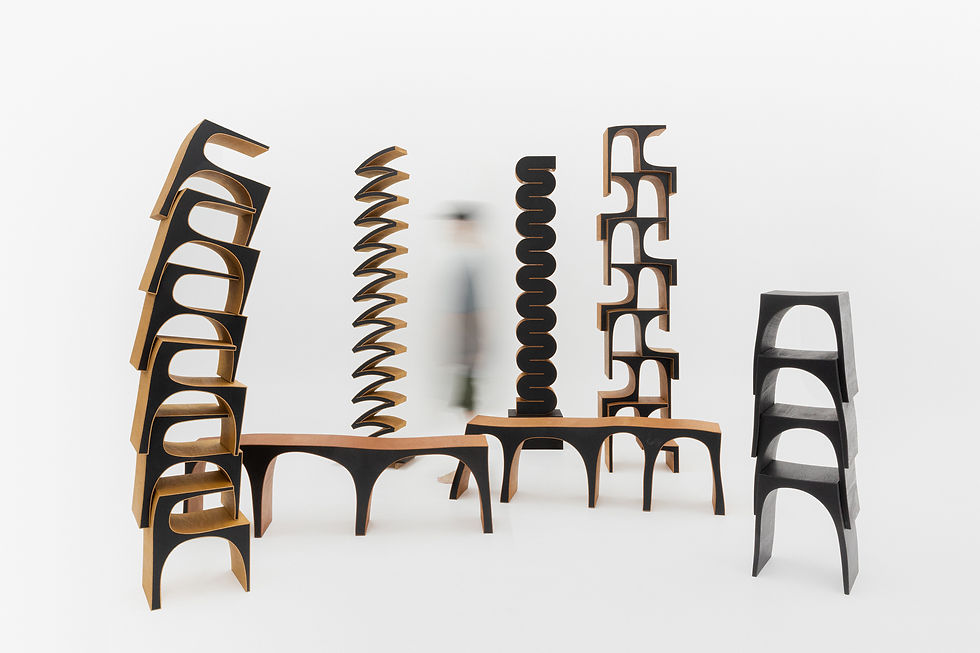
Yu Jeongmin : 쌓다 Stack
새로운 관계성을 구축하다.
디아(DIA) 컨템포러리에서는 9월 3일부터 9월 24일까지 유정민 개인전≪쌓다: Stack≫을 개최한다. 이번 전시는 반복과 곡선을 중심으로 조형 작업을 이어온 작가의 첫 개인전으로, 아트퍼니처와 조각의 경계를 허물고 새로운 관계성을 탐구하는 작품을 선보인다. 그리고 전통적인 장르의 개념을 도전하기보다는 개념적 특징들을 재해석하여 신선한 시각을 제시한다.
예술의 범주는 역사적으로 규정되어 온 카테고리이지 보편적인 카테고리는 아니다. 예술에서의 개념은 불변(不變)한 것이 아니라 역사적 맥락과 상황에 따라 변화의 여지를 가지고, 그 자체의 내재적 논리와 규범을 지니고 있다. 이전 조각 개념이 기념비적인 재현에서 벗어나고, 가구에 예술적 측면이 부각되었듯이 말이다. 특히 일상과 예술의 간극을 없애려는 포스트모더니즘은 개성, 자율성, 다양성, 대중성을 중시하고, 절대적 이념을 거부하며 다양한 양식의 예술 작품들을 등장시켰다. 회화와 조각에서의 변화만큼 공예와 디자인에서도 이러한 경계와 변화를 수용하며, 새로운 방식들을 모색해왔다. 그리고 과정을 거쳐 모든 개념이 융합된 오늘날의 예술은 이제 더 이상 주어진 매체의 정의나 인식에 따라 장르의 범주를 확정 짓지 않으며, 문화적 상황 속에서 논리적으로 적용되는 복합적 개념으로 발전하였다.
반복과 변형
홍익대학교 목조형가구학을 전공한 유정민은 아트퍼니처를 중심으로 작업을 시작하였다. 아트퍼니처는 가구의 실용성과 기능성에 나아가 심미적 창의성과 상상력을 요하는 분야이다. 작가는 대학 시절부터 미니멀한 가구의 형태에 스테이플러나 글루건 같은 다양한 기법과 재료를 사용하여 실험적인 시각을 제시하며, 재료의 확장성에 대해 도전하고 연구하였다. 이의 과정에서 낯선 요소들이 주는 신선한 재미를 가구에 접목하여, 기능성과 심미성의 간극 사이에 균형감을 찾으며, 조형물의 역할에 대해서 끊임없이 고찰하였다.
초기, 하나의 재료를 반복적으로 사용하는 방식을 통해 시각적 심미성을 추구하였던 작가는 이후, 오징어 합판이라는 주 재료를 만나 ‘반복’의 개념으로 확장하게 시켰다. 그리고 오징어 합판의 유연성을 재료의 물성에 대해 연구하고 잠재된 기능성을 끌어내며 다양한 형태의 작품을 선보여왔다. 많은 예술가들이 다양한 형태 가운데 ‘점’과 ‘선’을 통해 모든 형태의 본질적인 요소를 찾고자 했는데, 유정민은 자연스러운 ‘곡선’에 주목한다. 이는 그의 대표작 ‘아치 시리즈(Arch Series)’, ‘스플라인 시리즈(Spline Series)에서 잘 드러난다. 가장 아름다운 곡선의 미학인 ‘아치’를 통해 안정적인 형태의 아름다움을 제시하고, ‘스플라인’을 통해 곡선의 자유로움과 변형적인 모습을 담아내었다.
이러한 유정민의 작업은 일상의 삶과 유기적으로 연동하고 있다. 그는 일상에서 포착한 이미지를 시각적으로 형상화하며, 쉽게 인식할 수 있는 도상(Icon)으로 담백하게 표현한다. 도상은 일상에서 사물을 관찰하며 자신의 자전적인 경험과 기억에서 출발한다. 일상적인 사물과 움직임에 영감을 받아 뇌리에 박혀 있는 무형태의 기억을 형태로 구현한다. 작품에 나타나는 도상은 ‘미니멀 형식’의 간결하고 단순한 조합을 따르며, 뚜렷한 형상으로 묘사하여 작품에 집중하도록 한다. 이와 같은 표현 방식은 작가만의 고유한 작업 방식으로 자리 잡았다.
쌓다 : 아트퍼니처와 조각의 관계성
이번 개인전 ≪쌓다: Stack≫은 기존 가구의 개념을 새롭게 해석하고 확장하여, 장르의 고정된 틀을 넘어서는 시도를 담고 있다. 작가는 재료의 고유한 특성에서 비롯된 형태를 중시하며, 기존의 아치 시리즈를 순수미술의 설치작업으로 새롭게 해석, 발전시킨 작품들을 선보인다.
전시는 알바 알토(Alvar Aalto)의 대표작인 스툴체어의 적층 가능한 특성에서 영감을 받아 이를 출발점으로 삼았다. 스태킹 체어(Stacking Chair)는 적층 가능한 의자로 기능성과 실용성을 함께 가지는데, 유정민은 여기서 “쌓다”라는 행위 그 자체에 주목한다. 그동안 스툴을 대표작으로 선보였던 작가는 본 전시에서 스태킹 한 조형물을 선보인다. 신작 'Stacked Arch'은 적층 한 조형물이 하나의 조각으로 전환되고, 분리 시 각각이 가구로서의 기능을 갖는 특징을 지니는데, 이를 통해 가구와 조각의 효용성과 기능성에 대해 형태가 가질 수 있는 새로운 함의를 탐구하고자 한다.
비단 “쌓다”라는 행위는 외부적인 요소에만 국한되지 않는다. 작가의 “쌓다”라는 행위는 작품 제작 초기 단계부터 시작한다. 그는 작품의 구조적 안정성을 확보하기 위해 조형물의 내부에 골조를 세우는 방식으로 지지대를 쌓아 올리며, 단단한 연결고리를 장착한다. 이러한 과정을 거쳐 표면을 덮고 레진을 부은 뒤 갈아내는 과정을 거쳐 하나의 조형물을 완성한다. 그리고 완성된 조형물들은 다시 적층하여 현대미술에서의 조각 개념을 가진 새로운 조형물로 재탄생시키며, 가구와 조각의 경계를 넘나들어 그 관계성을 조율한다.
유정민은 실용적 의미나 감상적 의미의 오브제를 제안하기에 앞서, 관객의 시각에 따라 다른 의미를 수용하는 조형물에 대한 조형물에 대한 고찰을 담고 있다. 그는 다양한 프로젝트를 통해 가구가 특정 장소에서 기능적 역할을 가지는 반면 조각은 그 자체로 상징적인 언어가 될 수 있음을 경험하였다. 이러한 경험을 바탕으로 조형적 오브제가 가지는 특정 장르를 넘어 새로운 상황을 구축하는 작업의 존재 방식을 제안하며, 작품의 자율성에 대한 논의를 시작한다. 또한 이번 전시에서는 비정형적인 곡선에 대해 새로이 고찰한 입체 평면 작품도 함께 선보인다. 2022년부터 곡선의 표현에 다층적으로 변화를 시도한 작가는 처음으로 시도한 평면 작품을 통해 비정형적인 형태 내에서 발생하는 다양한 현상과 시각적 요소들을 인지하는 방식에 대해 관찰하고, 이로부터 현상학적 지각 경험을 이끌어 내고자 한다.
유정민은 이번 전시를 통해 삶과 예술의 경계를 넘나들며 아름답게 기능하는 아트퍼니처를 다른 방식의 읽기로 시도한다. 현대미술의 맥락에서 미(美)와 기능에 대한 균형을 논의하며, 익숙하지만 낯선 관점을 제시하여 감각과 인식의 확장을 추구한다. 그리고 경계를 구분 짓지 않고, 자신만의 색감을 찾아가는 작가의 첫걸음을 시작한다.
Building New Connections
From September 3rd to 24th, 2024, the DIA Contemporary showcases Yu Jeongmin’s solo exhibition ≪Stack≫. This is his first solo exhibition and he has continued to focus on repetition and curves in his sculptural works. Rather than deconstruct the genre’s general notions about art furniture and sculpture and go against the existing categories, conceptions, or tradition, he captures the conceptual characteristics of the genre and forges new connections in this exhibit.
Art forms are historically defined concepts rather than universal ideas. Concepts in art are not immutable, but are subject to change with history and circumstances, carrying the inherent logic and norms of art. Just like the concept of sculpture moved away from the portrayal of monuments. Just like the concept of furniture started to highlight artistic qualities. In particular, postmodernism, with its intention to eliminate the gap between daily life and art, emphasizes individuality, autonomy, diversity, and popularity; rejects absolute ideology; and produces various styles of works of art. Just as there were changes in painting and sculpture, new methods reflecting postmodernist boundaries were attempted in crafts and design as well. Through these changes and integration of diverse concepts, today’s art is no longer categorized according to the definition or perception of a given medium, but instead new boundaries have begun to be applied logically within a series of cultural contexts.
Repetition and Transformation
Yu Jeongmin has a bachelor’s degree in Woodworking and Furniture Design, and began his work in art furniture. As the product of the designer’s creative art and sensibility, art furniture requires aesthetic creativity and imagination while retaining the practicality and functionality of the furniture. From his college days on, Yu has experimented with various techniques and materials such as staplers and glue guns on minimalist furniture, challenging and examining the scope of materials that can be used. Through such unique attempts, Yu incorporated the refreshing excitement that comes with unfamiliarity into his furniture, finding a balance between functionality and aesthetics, and continuing to reflect on the purpose of sculptures themselves.
Early in his career, Yu sought to create visual aesthetics through the repeated use of a single material. Today, he has expanded the concept of ‘repetition’ through the use of his primary material, flexible plywood. By studying the material’s physical properties and drawing on its potential functionality, he has presented works of various forms utilizing the flexibility of the bending plywood. Many artists tend to search for the essential elements of all forms through ‘points’ and ‘lines’; however, Yu focuses on the pure, natural form of ‘curves’. This is evident in his representative works, ‘Arch Series’ and ‘Spline Series’. He demonstrates the beauty of stability through the most aesthetic of curves, the ‘arch’, and the freedom and transformative nature of curves through the ‘spline’.
Yu’s work is organically linked to everyday life. He expresses himself by visualizing the images captured from everyday life and simply delivering them in easily recognizable icons. The icons are born out of the artist’s autobiographical memories and experiences while he observes objects in life. They are snapshots of certain movements or inspirations drawn from daily lives, giving shape to the formless memories living in the artist’s mind. Icons found on the face of his works reflect the ‘minimalist style’, following clean and simple compositions and combinations, and their distinctive appearance guides the viewer to focus on the artwork. This has become Yu’s unique method of expression.
Stack: The Connection between Art Furniture and Sculpture
This solo exhibition ≪Stack≫ seeks to reinterpret and develop the existing concept of furniture and to depart from the restrictive context of the genre. Emphasizing the forms that were derived from the unique features of the material, the artist presents fine art installations that have been reinterpreted and evolved from his Arch Series.
The exhibit was inspired by Alvar Aalto's masterpiece, Stool 60, a uniquely shaped stool designed to be stacked and stored. A ‘stacking chair’, a term for furniture, refers to a chair that can be stacked and has both functionality and practicality. Here, Yu focuses on the act of "stacking" itself. In this exhibit, Yu presents stacked sculptures, building upon his representative work showcasing stools. His new work 'Stacked Arch' presents a stacked sculpture, of which the individual pieces serve as furniture when separated. In this way, each object of furniture and sculpture can be viewed through standards other than just utility or functionality, allowing us to recognize that a form can carry new meanings and implications.
However, the act of “stacking” is not limited to external elements. The artist’s act of “stacking” begins from the early stages of creating his work. For structural stability, he stacks supporting modular pieces and links them with strong connectors in the internal space of the sculpture in a similar way a framework is constructed. Through this process, the support force is evenly distributed to achieve stability. Next, he covers the surface, pours resin, and then grinds it out to complete the piece of sculpture, which is, by itself, considered an independent object to explore. Then, he stacks each completed piece one by one, transforming them into a new sculpture under the modern art’s concept of sculpture. The artist repeatedly goes back and forth between the ‘furniture’ and the ‘sculpture’, recalibrating the connection between the two.
Before suggesting an object for practicality or for sentimental significance, the artist first contemplates sculptures carrying different meanings depending on the perspective of the viewer. Through various projects, Yu came to understand that the function of furniture is restricted by the space it is placed in, whereas a sculpture may become a symbolic language in itself regardless of where it is situated. With this experience, Yu proposes a way to create a new space beyond the traditional genres for the roles of sculptural objects. Thus he initiates a discussion on the autonomy of the works themselves. Additionally, this exhibit includes two-dimensional works that newly examine atypical curves. Since 2022, Yu has attempted to make multi-layered modifications on his expressions of curves. In his first-ever two-dimensional works, Yu tries to observe the ways various phenomena and visual elements appear within the atypical two-dimensional structure and to elicit an experience of phenomenological perception that occurs within this space.
In summary, the artist attempts to reinterpret art furniture in a different way, when art functions beautifully, crossing the boundaries between everyday life and art. Through the lens of modern art, he discusses the balance between beauty and function. As he opens up and shares a perspective that is simultaneously familiar and foreign, Yu aims to obtain freedom through the enhanced senses and expanded perception. This is his first step toward finding his own sense of color without any boundaries.
SELECTED ARTIST
INSTALLATION VIEW
I'm a paragraph. Click here to add your own text and edit me. It's easy.


SELECTED ARTWORKS


bottom of page